

A running watch helps you track distance, pace, and progress without juggling your phone mid-run. Basic phone apps can record routes, but they rely on your phone’s battery and offer less convenient at-a-glance stats while you move.
For clearer feedback on every run, a Garmin running watch tracks your workout from your wrist using GPS and built-in sensors. You can check your pace as you go, then review distance and other activity data afterward without carrying your phone in your hand.
Many models offer heart-rate tracking, training suggestions, recovery insights, and route guidance, helping you pace efforts and plan future runs. Long battery life on select watches also means fewer charging breaks between workouts.
Garmin running watches vary in size, battery life, mapping features, and training tools, so consider your routine and goals before deciding. Explore the best rated garmin running watches below to find a watch that suits your miles.
7 Best Rated Garmin Running Watches Reviews

1.Garmin fēnix 8 Multisport GPS Smartwatch
Up to 16 days of battery life in smartwatch mode keeps you ready to go
2.Garmin Forerunner 245 Music GPS Running Watch
Training status shows when you’re undertraining or pushing too hard

3.Garmin Instinct Solar Rugged GPS Watch
Solar charging extends battery life beyond traditional charging

4.Garmin Venu Sq GPS Smartwatch
More than 20 preloaded sports apps give you new ways to keep moving

5.Garmin fēnix 7 Pro Sapphire Solar GPS Watch
Solar lens uses sunlight for weeks of battery life in smartwatch mode

6.EZON T031B01 GPS Running Watch
Records up to 50 laps with duration, pace, distance and average speed

7.Garmin vívoactive 3 GPS Waterproof Smartwatch
GPS and GLONASS track activities, with 5 ATM water resistance built in
1. Garmin fēnix 8 Multisport GPS Smartwatch
Garmin fēnix 8 is a multisport watch for tracking runs, training and outdoor routes. Its multi-band GPS works with SatIQ technology, while a compass, gyroscope and barometric altimeter support navigation.
The 1.4-inch AMOLED display presents workout details, maps and health readings. For training, built-in sports apps, sport-specific workouts, strength plans and real-time stamina tracking help you follow different activities.
Battery life reaches up to 16 days in smartwatch mode or 47 hours with GPS. A readiness score draws on sleep quality, recovery, training load and HRV status to help you judge how much training to take on.
For runners who want route guidance, round-trip routing uses your target distance to provide turn-by-turn directions and adjust the route back to your starting point. The built-in LED flashlight can help you see after dark.
It also tracks heart rate, sleep, respiration and Pulse Ox, and its ECG app can record heart rhythm and check for signs of atrial fibrillation. These readings are estimates, and the ECG app is limited by region and intended for people 22 or older.
A built-in speaker and microphone let you take calls when paired with a smartphone, while off-grid voice commands control select watch functions without a phone connection. With a 40-meter dive rating and stainless steel bezel, it suits runners who also want multisport training and outdoor features.
- Up to 47 hours of battery in GPS mode
- Multi-band GPS and sensors aid navigation
- AMOLED display and built-in LED flashlight
- Training plans and stamina tracking for athletes
- ECG app has regional and age limits
- Health metrics are estimates, not medical readings
2. Garmin Forerunner 245 Music GPS Running Watch
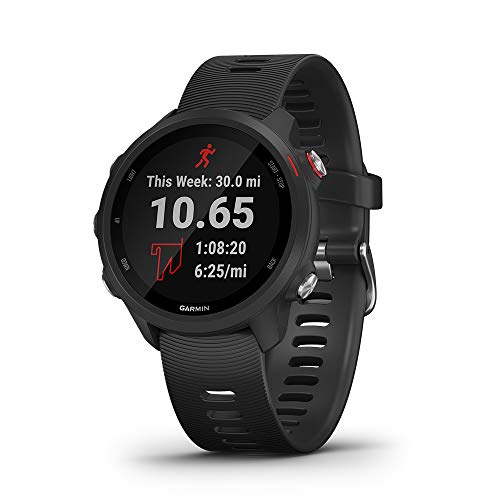
For runners who want training guidance and music on their wrist, the Garmin Forerunner 245 Music pairs GPS tracking with tools for monitoring performance. Its training-status feature checks whether your workouts point to undertraining or too much training.
Garmin Coach offers adaptive training plans at no cost, and you can also build custom workouts through Garmin Connect. That gives runners options for following a plan or shaping sessions around their own goals.
The watch can sync with music services such as Spotify and store songs for playback from your wrist. In GPS mode with music, battery life reaches up to 6 hours; smartwatch mode lasts up to 7 days between charges.
Advanced running dynamics include ground contact time balance, stride length and vertical ratio. Those measurements require a Running Dynamics Pod, HRM-Run or HRM-Tri monitor, which you must buy separately.
For select activities, incident detection can send your live location to emergency contacts through a compatible paired smartphone. Corning Gorilla Glass 3 covers the lens, while the bezel uses fiber-reinforced polymer and the strap uses silicone. This black watch suits runners who want training feedback, music and GPS in one device.
- Up to 7 days of battery in smartwatch mode
- Stores Spotify songs for playback from your wrist
- Garmin Coach offers free adaptive training plans
- Tracks advanced running dynamics with compatible sensors
- Advanced running dynamics need a separate sensor
3. Garmin Instinct Solar Rugged GPS Watch
100 meters of water resistance lets the Garmin Instinct Solar handle swimming and wet-weather runs. Its rugged build also meets U.S. military standard 810 for thermal and shock resistance, making it suited to outdoor training and everyday wear.
For routes beyond familiar paths, the watch combines GPS with GLONASS and Galileo satellite systems. A built-in 3-axis compass and barometric altimeter add direction and elevation information, giving runners more navigation tools in challenging environments.
Solar charging can extend battery life beyond traditional charging, though the data does not state how much extra runtime it provides. That can be useful on longer outings away from a charger, while Bluetooth provides wireless connectivity.
The watch tracks running, biking, swimming, strength training and other activities. Its all-day health monitoring includes Pulse Ox, while Body Battery estimates how your body uses energy by tracking heart rate, stress and sleep.
These health features can help you review activity and recovery patterns over time. Garmin notes that Pulse Ox is not a medical device and is not intended to diagnose or monitor medical conditions.
At about a third of a pound, the Graphite watch has a rugged outdoor focus rather than a lightweight running-watch profile. It suits runners who want multi-satellite navigation, solar charging and activity tracking in one watch.
- GPS, GLONASS and Galileo support route tracking
- Compass and altimeter aid outdoor navigation
- Solar charging can extend battery life
- Tracks running, swimming and other activities
- Water-rated to 100 meters for swimming
- No major cons
4. Garmin Venu Sq GPS Smartwatch
Runners who want health tracking and everyday smartwatch tools get a bright color touchscreen and GPS features with the Garmin Venu Sq. Its display has an always-on mode, so you can check the time and information with a quick glance.
More than 20 preloaded sports apps include running, walking, cycling, swimming and golf. Preloaded workouts cover cardio, yoga, strength training and Pilates, and you can make custom workouts in the Garmin Connect app on a compatible smartphone.
The watch tracks estimated heart rate, respiration, stress, sleep, hydration and menstrual cycles. Its Body Battery feature provides an energy-level estimate, giving you several measures to check alongside your exercise.
Battery life reaches up to six days in smartwatch mode or up to 14 hours in GPS mode. The Light Gold watch with a White band fits wrists from about 4.9 to 7.5 inches around.
When paired with a compatible smartphone, it can show calls, texts and social media alerts. Garmin Pay supports contactless purchases through participating payment networks, while incident detection during select activities can send your live location to designated contacts.
You can change the watch face and add apps or widgets through Connect IQ with a compatible phone or computer. This renewed Garmin suits runners who want varied activity tracking and smartwatch functions in one wrist-worn device.
- Up to 14 hours of battery life in GPS mode
- More than 20 sports apps, including running
- Tracks sleep, stress, hydration and more
- Always-on color display supports quick checks
- No major cons
5. Garmin fēnix 7 Pro Sapphire Solar GPS Watch
On trails and around town, the Garmin fēnix 7 Pro Sapphire Solar gives runners GPS navigation, training insights and health tracking in a 47 mm watch. Its 1.3-inch display sits under a scratch-resistant Power Sapphire lens that gathers solar energy to extend smartwatch battery life.
Multi-band GPS with SatIQ technology helps pinpoint your position while managing battery use. Navigation tools include TopoActive maps, golf course and ski resort maps, and Up Ahead prompts that flag points along your route.
Hill Score tracks running strength and endurance on climbs, while Endurance Score combines data from different sports to show how training affects stamina. Wrist-based running power, strength training tools and pacing modes add options for planning workouts and race efforts.
Health and recovery features run around the clock, including HRV status, Pulse Ox and sleep monitoring. Morning Report and Training Readiness bring health and training information together, though the watch’s measurements are estimates and it is not a medical device.
The built-in LED flashlight offers adjustable brightness and strobe modes for night training. Its 47 mm fiber-reinforced polymer case has a titanium bezel and rear cover, and the watch weighs about 0.16 pounds.
This Carbon Gray DLC Titanium model comes with a black band. It suits runners who want detailed training metrics, route guidance and solar charging in a multisport watch.
- Solar lens extends smartwatch battery life
- Multi-band GPS guides routes with precision
- Hill and endurance scores track progress
- Built-in flashlight helps on night runs
- No major cons
6. EZON T031B01 GPS Running Watch
GPS tracking is the EZON watch’s main feature, giving runners distance and pace data on runs, hikes and other outdoor activities. A cold start takes about a minute, while a hot start reconnects immediately.
After a workout, one button brings up distance, average pace, calories burned and total time. The watch saves the last 10 exercise records, so you can check recent sessions without writing the details down.
Its stopwatch runs for up to 99 hours, 59 minutes and 59 seconds, and it supports countdown and lap timing. It can save data for up to 50 laps, including each lap’s duration, pace, distance and average speed.
The built-in GPS also sets the time based on your selected city. You can enter your height, weight, age and gender, then choose imperial or metric units for personalized fitness tracking.
A 5ATM water-resistance rating covers swimming, showers and handwashing, though you should not press its buttons underwater or wear it for diving or sauna use. The matte black watch also has an alarm that chimes for about 20 seconds.
This is a basic GPS running watch for people who want workout and lap records without a focus on Garmin features. Its listed weight is about 0.13 pounds, and its alarm adds a reminder for everyday use.
- GPS tracks distance and pace outdoors
- Stores data for up to 50 laps
- Saves the last 10 exercise records
- 5ATM water resistance suits swimming
- GPS cold start takes about a minute
7. Garmin vívoactive 3 GPS Waterproof Smartwatch
Garmin’s vívoactive 3 is a GPS smartwatch for runners who want location tracking and a water-resistant watch in one device. Its built-in GPS and GLONASS support provide satellite positioning for tracking outdoor runs.
The watch has a 1.2-inch display and a stainless steel finish in white, according to the product title. The compact screen keeps watch information on your wrist, while the metal finish gives it a dressier look for everyday wear.
With a 5 ATM water-resistance rating, it can handle water pressure equivalent to a depth of 50 meters under test conditions. That rating makes it suitable for swimming as well as runs in wet weather, though it does not say that the watch has a dedicated swim-tracking feature.
The listing describes it as a renewed smartwatch and gives its color as multicolor, despite the title’s white stainless steel description. It weighs about 0.1 pounds, so it adds little weight to a running kit or daily outfit.
The available product details do not identify battery life, screen resolution, running metrics, or phone compatibility. Buyers who need those specifics should check the seller’s listing before choosing it for training.
It is a fit for runners who want GPS and GLONASS location support, plus 5 ATM water resistance, in a lightweight Garmin watch; shoppers who need detailed training or battery specifications may want more information first. As our final pick, it keeps the focus on those stated basics.
- GPS and GLONASS support outdoor location tracking
- 5 ATM rating suits swimming and wet-weather runs
- Weighs about 0.1 pounds for light wear
- Listing gives little detail on running metrics
How to Choose the Best Rated Garmin Running Watches
Choosing a running watch is about matching its tracking, battery life, fit and training tools to how you run. Your budget, need for maps or music, and tolerance for a larger watch all shape the right choice.
| If You Need | Look For | Expect |
|---|---|---|
| Simple run tracking | Built-in GPS, pace and distance | Fewer training tools |
| Long outings | Long GPS battery life | Larger, heavier case |
| Route guidance | Maps, compass and altimeter | Higher cost and setup |
| Music-free phone access | Music storage or playback | Shorter GPS battery life |
| Training guidance | Plans, recovery and load metrics | More data to interpret |
| Daily wear | Comfortable fit, readable display | Fewer rugged features |
GPS Accuracy and Route Tracking
GPS records your route, distance and pace, so its reliability affects nearly every run. Look for a watch that supports more than one satellite system; multi-band GPS adds another layer of positioning support in difficult areas.
Tall buildings, tree cover and steep terrain can slow location fixes or create route errors. If you run in those places, compare satellite options and look for settings that balance accuracy with battery use.
For open roads and familiar routes, standard GPS is often enough. Multi-band tracking suits runners who need more dependable positioning in challenging surroundings, but it generally uses more battery during an activity.
Battery Life in Use
Battery figures describe different things: smartwatch mode, GPS use, and GPS with music. Compare the mode you will actually use, because a long standby estimate does not tell you how long a watch lasts during a lengthy run.
For regular short runs, several days between charges may be enough. Long-distance runners, hikers and people who track activities all day should prioritize stronger GPS endurance and a charging routine that fits their schedule.
Music playback and frequent GPS use usually shorten runtime. Solar charging can extend battery life in suitable conditions, but treat it as a supplement rather than a replacement for checking the stated GPS estimate.
Comfort and Case Size
A watch should sit securely without rubbing, and its weight is more noticeable over long runs. Compare case diameter and thickness with your wrist, especially if you prefer a light feel or wear the device overnight.
Larger cases often provide room for bigger displays and batteries, but they can feel bulky under sleeves. Smaller cases suit narrow wrists and low-profile wear, though their screens may show less information at once.
Try the strap adjustment range and confirm replacement bands are available. A snug fit helps wrist-based heart-rate readings, while a strap that is too tight can irritate skin during longer sessions.
Training and Running Metrics
Basic watches record time, pace and distance; advanced models add training status, stamina, recovery or hill-related measures. Decide whether you will use those details to plan sessions or whether a simpler summary is easier to follow.
Training plans can help structure workouts, while advanced running dynamics may require a compatible sensor. Before paying for extra metrics, confirm what the watch measures by itself and what depends on another device.
Heart-rate variability, sleep and stress estimates offer context about recovery, but they are not medical readings. These features suit runners who review trends over time, not buyers seeking a diagnosis from a wrist device.
Navigation and Outdoor Use
A compass and barometric altimeter help with direction and elevation, while downloadable maps provide more route detail. For city loops, these tools may add little; for unfamiliar trails, they can help you stay oriented.
Check whether navigation means a breadcrumb route, map display or turn prompts, since those functions are not interchangeable. Map storage and route tools are most useful when you plan routes before leaving or run where phone service is unreliable.
A rugged build and stronger water rating suit rough outdoor use, but they do not guarantee comfort or suitability for every water activity. Match the rating to your actual exposure, and review the maker’s limits for swimming or diving.
Display and Everyday Controls
A bright touchscreen is easy to read and tap, but wet fingers, gloves or cold weather can make touch controls less convenient. Buttons are easier to operate by feel, so compare control styles with your usual conditions.
Display size and readability affect how quickly you can see pace while moving. A high-contrast screen with clear data fields helps during workouts, while a more detailed color display may use more power.
An always-on setting keeps information visible, but it can reduce battery life. Choose it if quick glances matter more than charging less often, and check whether the display remains readable in direct sunlight.
Music, Calls and Safety
Stored music lets you leave your phone behind, but playback can cut GPS runtime substantially. Confirm how music transfers to the watch and whether you need wireless headphones or a paid service.
A built-in speaker and microphone support calls on compatible devices, but they do not replace carrying a phone for dependable contact. Check phone compatibility and call requirements if hands-free access is part of your routine.
Incident detection is available only during certain activities on some watches, and setup may require a paired phone. Treat it as an added alert feature, not a substitute for route planning or personal safety steps.
Price and Condition
At lower prices, expect core run recording and fewer navigation or training features. Mid-priced options often add plans, health tracking or music, while premium models tend to combine richer mapping, stronger GPS options and more outdoor tools.
Pay more when a specific feature solves a real need, such as long GPS endurance or route guidance. If you mainly run familiar routes and review pace, a simpler watch may cover the essentials without extra cost.
Renewed watches cost less, but condition, included accessories and return terms vary by seller. Confirm battery condition where available, warranty coverage, and whether the listing includes the correct charging cable and strap.
Compatibility and Warranty
Before buying, confirm the watch works with your phone’s operating system and the app features you plan to use. Music, notifications, safety alerts and data syncing may depend on a paired phone or compatible accessories.
Warranty length and coverage differ by seller, especially for renewed devices. Read the return window and ask how defects, battery problems and missing parts are handled before relying on a low listed price.
Also check whether the charging cable, replacement bands and external sensors are easy to find. A compatible accessory ecosystem helps you keep the watch useful as your training needs change.
Frequently Asked Questions
Are these watches rechargeable, or do some use solar power?
The Garmin fēnix 8 and Forerunner 245 Music are rechargeable, while the Instinct Solar and fēnix 7 Pro Sapphire Solar can extend battery life with solar charging. Check each model’s product details for its charging requirements.
Which watches are built for rugged use or water activities?
The Garmin Instinct Solar is described as rugged, while the vívoactive 3 has 5 ATM water resistance. Check the manufacturer’s guidance for the activities and water conditions suitable for each watch.
What comes in the box with these watches?
The listed product details don’t specify box contents, which may vary by model or seller. Check the product listing to confirm whether charging cables or other accessories are included.
Should I choose the Garmin fēnix 8 or the fēnix 7 Pro Sapphire Solar?
Choose the fēnix 8 if its listed smartwatch battery life of up to 16 days suits your needs; consider the fēnix 7 Pro Sapphire Solar if solar charging is your priority. Compare the full specifications before deciding.
Which watch is useful for tracking laps and pace?
The EZON T031B01 records up to 50 laps with duration, pace, distance, and average speed. It may suit buyers who want those running metrics.
How can I tell whether I’m training too hard or not enough?
The Garmin Forerunner 245 Music provides training status to show when you may be undertraining or pushing too hard. Use that information alongside your own training plan.
How can I find a watch with more ways to track activities?
The Garmin Venu Sq includes more than 20 preloaded sports apps. The Garmin vívoactive 3 also tracks activities using GPS and GLONASS.
So, What Should You Buy?
For most runners, the Forerunner 245 Music is a strong pick, thanks to training-status guidance that helps flag when you’re undertraining or pushing too hard. On a budget, consider the EZON T031B01 for lap, pace, distance, and speed records; for broader activity options, the Venu Sq offers more than 20 preloaded sports apps.
Need extra battery life? Choose the fēnix 8 or fēnix 7 Pro Sapphire Solar; the Instinct Solar also suits rugged outings. For water-resistant activity tracking, consider the vívoactive 3. Choose the Garmin that matches your priorities and get moving.