

A running watch can make each mile easier to manage, helping you track distance, check your pace, and keep your training on course. A phone app can record a run too, but carrying your phone may feel bulky, and checking its screen mid-stride can interrupt your rhythm.
For steadier feedback, a running watch uses GPS to map your route and estimate pace and distance as you go. You can glance at your wrist instead of reaching for your phone, then review your run afterward to see how far and fast you went.
Many models also track heart rate, count steps, and offer interval timers, so you can follow workout targets and notice changes over time. Long battery life helps on extended runs, while water resistance suits sweaty sessions and rainy routes.
Screen size, GPS accuracy, battery life, and training tools vary, so consider what matters most for your runs. Explore the best running watches for pace and distance below to find one that suits your routine.
7 Best Running Watches for Pace and Distance Reviews

1.EZON T031B01 GPS Running Watch with Pace
GPS tracks distance and average pace to help you focus each workout

2.POLAR Street X GPS Running Sports Watch
Built-in GPS and route guidance track distance and pace on your runs
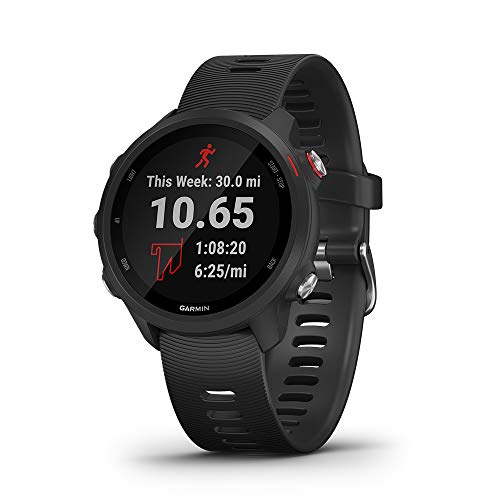
3.Garmin Forerunner 245 Music GPS Watch
Training status shows when to ease up or push harder in your runs

4.Casio STR300-7 Runner Series Sports Watch
Pace signal and distance calculation help you measure your runs

5.G-Shock GBD200-9 G-Squad Move Fitness Watch
Phone GPS calibrates distance for pace readings and Auto Lap on runs

6.Casio GBD-H1000-4 G-Shock GPS Running Watch
GPS tracks distance and pace, while heart rate data guides training

7.findtime SD2197 Pedometer Watch with Compass
Tracks steps, distance, calories and exercise minutes as you move
1. EZON T031B01 GPS Running Watch with Pace
EZON GPS Running Watch handles pace and distance tracking for runners who want workout details without relying on a phone. Its GPS gets a cold start in about one minute and reconnects with an instant hot start, so you can track runs, hikes and other outdoor activities.
After a workout, one button brings up distance, average pace, calories burned and total time. The watch saves your 10 most recent exercise records, giving you a way to check past sessions as you plan future training.
Lap tracking suits runners who want to review parts of a workout, not just the overall result. The stopwatch supports countdown and lap modes for up to 99 hours, 59 minutes and 59 seconds, and it can store details for as many as 50 laps.
You can enter your height, weight, age and gender, then choose imperial or metric units for fitness calculations. The built-in GPS also sets the time based on your selected city, while an alarm chimes for about 20 seconds and stops when you press any button.
Its 5ATM water resistance covers swimming, showering and everyday handwashing, though you should not press buttons underwater or wear it for diving or sauna use. This matte-black watch suits runners who want GPS pace and distance tracking with lap data and basic daily reminders.
- GPS tracks distance and pace on outdoor runs
- Saves distance, pace, calories, and total time
- Stores lap details for up to 50 laps
- 5ATM rating supports swimming and showers
- Saves only the 10 most recent workouts
2. POLAR Street X GPS Running Sports Watch
For city runs, outdoor training and hybrid workouts, the Polar Street X tracks pace and distance with built-in GPS. Route guidance helps you follow a planned course, while back-to-start navigation can guide you back toward where you began.
The watch also records performance across more than 170 sport profiles, including running, strength training, HIIT and cycling. That range suits runners who mix road sessions with gym work or other activities.
Wrist-based heart rate tracking shows real-time data without a chest strap. You can use that information to monitor effort during a run or training session.
Battery life reaches up to 10 days, and GPS tracking lasts up to 43 hours. The AMOLED display and built-in flashlight round out the features named in the title.
Its shock-resistant build and 50-meter water resistance suit gym sessions, rain and everyday knocks. At about 48 grams, this Night Black watch is light enough for all-day wear, and the S-L size is listed in the specifications.
With route tools, broad sport coverage and long GPS battery life, it suits runners who want pace and distance tracking alongside options for varied training.
- Built-in GPS tracks pace and distance on runs
- Route guidance and back-to-start navigation aid routes
- Up to 43 hours of GPS tracking between charges
- 170+ sport profiles cover varied training routines
- No major cons
3. Garmin Forerunner 245 Music GPS Watch
Up to 7 days of smartwatch battery life makes the Garmin Forerunner 245 Music useful for daily wear, while GPS mode with music lasts up to 6 hours. It tracks runs with GPS and includes music storage and playback.
For pace and distance training, its GPS running features pair with advanced running dynamics. Ground contact time balance, stride length and vertical ratio provide additional running measurements, but require a separately sold Running Dynamics Pod, HRM-Run or HRM-Tri monitor.
The watch evaluates your training status and indicates whether you may be doing too little or pushing too hard. You can also use free adaptive plans from Garmin Coach or create custom workouts through Garmin Connect.
Music streaming services such as Spotify can sync with the watch, so you can store and play songs from your wrist. During select activities, incident detection can send your real-time location to emergency contacts through a paired compatible smartphone.
Corning Gorilla Glass 3 covers the lens, while a fiber-reinforced polymer bezel and silicone strap make up the black watch. At about 0.08 pounds, it suits runners who want GPS tracking, training guidance and music in a lightweight watch.
- Up to 7 days of battery in smartwatch mode
- GPS and music playback for run tracking
- Training status flags under- or overtraining
- Stores Spotify music for runs without phone
- Advanced running dynamics need a separate sensor
4. Casio STR300-7 Runner Series Sports Watch
Runners who want pace and distance information from a simple wristwatch get dedicated functions in the Casio STR300-7. Its pace signal and distance calculation functions are the most relevant tools for tracking a run, though the listing does not explain how distance is measured.
The 1/100-second stopwatch records elapsed time in fine increments, which helps runners check their pace during a workout. Its memory holds up to 60 laps, so you can review multiple splits instead of relying only on the finish time.
Water resistance to 50 meters gives the watch protection for swimming and wet conditions, as well as sweaty runs. The listing identifies it as part of Casio’s STR300 Runner Series, a line aimed at runners who want timing features on their wrist.
A 10-year battery life means you can spend less time planning battery changes during regular use. The listed weight is about 0.06 pounds, so the watch adds little weight to a running kit.
The white adult-size watch has resin glass over its display. The product information does not state display dimensions, GPS, or phone connectivity, so buyers seeking mapped routes or connected run records may want a different kind of running watch.
For runners who mainly want lap timing, pace signals and distance calculations in a lightweight watch, this Casio covers those basics. It suits people who value straightforward run tracking and long battery life over connected features.
- 60-lap memory helps track running splits
- Pace and distance functions support run tracking
- 10-year battery means fewer battery changes
- 1/100-second stopwatch tracks elapsed time
- No major cons
5. G-Shock GBD200-9 G-Squad Move Fitness Watch
On a running route, the G-Shock G-Squad Move tracks pace and distance with help from your phone’s GPS. Bluetooth links the watch to a smartphone, letting its accelerometer calibrate distance measurements more quickly.
The watch calculates running pace from distance and time, while Auto Lap can mark intervals during a run. These tools help runners check their speed and split times as they train.
It also measures steps, lap times and calories burned, and includes interval timers for structured workouts. A smartphone app keeps LifeLog and activity history data available for reviewing past sessions.
For runs after dark, a front button brings up the display illumination. The square digital face comes in yellow and black, while the title describes the strap as lime green resin.
Soft urethane makes up the band, and extra holes give you more options for adjusting its fit. The watch weighs about 0.35 pounds, according to the specifications.
This connected fitness watch suits runners who want pace and distance readings alongside basic workout tracking, especially if they carry a smartphone for GPS calibration. Its activity history also helps people keep tabs on everyday movement between runs.
- Phone GPS helps calibrate distance readings faster
- Tracks running pace and supports Auto Lap
- Logs steps, laps, calories and interval workouts
- Front button lights the display for night runs
- Distance calibration depends on a linked phone
6. Casio GBD-H1000-4 G-Shock GPS Running Watch
GPS tracking gives this Casio running watch a way to record position, pace and distance. It also uses accelerometer data to calculate training values, so you can follow runs with GPS or motion-based measurements.
The display can show speed, pace, distance, lap times and heart rate. Auto Pause, automatic run timing and adjustable alerts for time, altitude or calories help tailor what the watch records during a workout.
Wrist-based heart-rate readings reach up to 220 beats per minute. You can set a target heart rate and check heart-rate zones, graphs, maximum and minimum readings, then review aerobic and anaerobic training effects.
After a run, training analysis includes VO2MAX, recovery time, fitness-level trends and training-load trends. The watch stores data from up to 100 runs, with as many as 140 lap times for each run.
Its GPS can receive position and time information manually, while Bluetooth mobile linking supports wireless connection. The red resin-strap watch is shock resistant, water resistant to 200 meters and powered by Tough Solar; it also has an LED backlight and compass, altimeter, barometer and thermometer.
This watch suits runners who want pace and distance tracking alongside heart-rate and training analysis. Its many data fields also make it useful for people who want to examine workout details after a run.
- GPS and accelerometer track pace and distance
- Stores data from up to 100 runs
- Wrist heart-rate readings reach 220 bpm
- Tough Solar charging supports longer use
- GPS time updates only once per day automatically
7. findtime SD2197 Pedometer Watch with Compass
findtime makes this non-Bluetooth watch for runners who want step, distance and exercise tracking without an app. It records steps automatically, along with distance walked or run, calories burned and exercise minutes, giving you several activity measures on your wrist.
The compass can help you check direction on hikes or runs away from familiar routes without relying only on GPS. Its large digital display shows the time, and the watch also has a pacer, stopwatch and countdown timer for timing workouts.
An alloy bezel, ABS case and nylon strap make up the watch’s outdoor-oriented build. The strap is breathable, while the stainless steel back supports its water resistance for swimming, handwashing, cold showers and rain; avoid pressing buttons underwater.
You can also set an alarm and choose 12- or 24-hour time. The LED backlight helps you read the display in low light, and the week and calendar functions cover everyday timekeeping.
At about 0.14 pounds, it adds little weight for running or camping. This is a practical fit for runners who want basic pace-related activity records and a compass, but don’t need Bluetooth or an app.
- Tracks steps, distance, calories and exercise minutes
- Compass helps with direction away from GPS
- Light at about 0.14 pounds for outdoor use
- Water resistant for swimming, rain and showers
- No Bluetooth connection or companion app
How to Choose the Best Running Watches for Pace and Distance
Choosing a running watch for pace and distance means weighing GPS accuracy against battery life, ease of use and price. Your routes, training habits, phone use and need for extra features all affect which trade-offs make sense.
| If You Need | Look For | Expect |
|---|---|---|
| Reliable outdoor pace | Built-in GPS, recorded route | More frequent charging |
| Long training sessions | Extended GPS battery life | Larger, heavier watch |
| Simple run tracking | Distance, pace, lap memory | Fewer training tools |
| Music without a phone | On-watch music storage | Shorter GPS battery life |
| Navigation on unfamiliar routes | Route guidance, back-to-start | More setup and cost |
| Workout feedback | Heart rate, recovery metrics | More data to interpret |
| Low-maintenance daily wear | Long battery, simple display | Fewer connected features |
GPS Accuracy and Pace
Built-in GPS measures your route without relying on a phone, so it suits outdoor runs where pace and distance need to appear on your wrist. Reception can vary near tall buildings, dense trees and tunnels.
Look for satellite tracking that starts promptly and holds a signal, plus route recording if you want to inspect where readings changed. A slow initial connection can delay the start of a workout.
Instant pace often jumps because GPS updates are imperfect, especially around turns or under cover. Average pace over a lap or a full run gives a steadier view for pacing workouts.
For treadmill sessions, GPS distance is not the right measure; look for indoor run tracking or a way to calibrate distance after running. Phone-assisted distance instead depends on carrying and connecting your phone.
Distance and Pace Tools
The core display should show distance and a pace unit you understand, such as minutes per mile or minutes per kilometre. Make sure the watch lets you choose the units before your first run.
Lap splits help you see whether each section of a workout stays near your target pace. For structured training, look for automatic laps, manual lap marking, or both, then confirm how many laps the watch stores.
A pace alert can warn you when you drift outside a chosen range, which helps during intervals or steady efforts. Simpler watches may show only average pace and distance, which may be enough for casual runs.
Battery Life
Compare battery life during GPS tracking, not just the everyday watch estimate, because GPS use drains power faster. A watch with several hours of GPS runtime suits most short runs, while longer outings need more reserve.
Music, bright displays, frequent heart-rate readings and navigation also use power. If you run for several hours or train on multiple days between charges, look for a longer GPS estimate and a clear charging method.
Battery figures are maximum estimates, not guaranteed results in every setting. Cold weather, older batteries and frequent screen use can shorten runtime, so leave a buffer rather than planning a long run around the stated limit.
Screen and Controls
A readable screen helps you check pace quickly without slowing down or squinting. Large numbers and strong contrast suit quick glances; colour or high-resolution displays can show more information but may use more battery.
Buttons are useful when rain, sweat or gloves make a touchscreen awkward. Check whether the controls are easy to operate while moving, and whether you can keep your main running fields visible during exercise.
Backlighting matters for early mornings and evening runs. A front button or automatic illumination can make the display easier to read, while smaller screens may limit how many metrics appear at once.
Training and Heart Rate
Wrist-based heart rate adds workout intensity data without a separate chest strap, but readings can lag during fast intervals. A compatible chest monitor is worth considering if you rely on precise heart-rate zones.
Training status, recovery estimates and oxygen-use estimates can help you adjust effort across a training week. These numbers are estimates, so treat them as supporting information rather than a medical assessment or exact measure of fitness.
For planned workouts, look for interval timers, custom workout support or guided training plans. Basic stopwatch and lap tools suit runners who build their own sessions, while detailed coaching features help those following structured plans.
Navigation and Safety
Route guidance and a back-to-start function help when you run unfamiliar paths, but they require setup and can use extra battery. Look for clear route instructions if you often run trails or explore new areas.
Some watches offer incident alerts that rely on a paired phone and a supported activity. That setup does not replace carrying a phone or telling someone your route, so confirm the conditions before depending on it.
A compass helps with direction, while an altimeter estimates elevation and a barometer tracks air-pressure changes. Those tools matter more for trail or outdoor use than for familiar road loops.
Fit and Water Protection
A watch should sit securely without bouncing, because movement can make screen reading and wrist heart-rate readings less comfortable. Check its weight, case size and strap adjustment range, especially if you have a smaller wrist.
Water-resistance ratings describe tested conditions, not unlimited protection in every situation. A 5ATM or 50-metre rating generally suits swimming and rain, but follow the maker’s guidance for buttons, hot showers and water sports.
A lightweight, soft strap can feel less distracting on daily runs, while a rugged case may suit rough outdoor use. Try to judge fit with the display and buttons in the positions you will use.
Phone and App Connection
A watch with phone connection can sync runs, show activity history and use phone GPS for distance calibration. Confirm that the app works with your phone and that the features you need do not require a paid subscription.
Phone-free GPS is useful when you want to leave your phone at home, while music features may let you listen without carrying it. Check whether music is stored on the watch or streamed through a phone.
If you prefer a simple device, a watch without an app avoids pairing and account setup. The trade-off is less convenient review of long-term trends, route maps and detailed workout history.
Price and Ongoing Costs
Lower-priced watches usually focus on time, stopwatch, distance, pace and basic lap records. They suit runners who want essential numbers, but may lack route maps, advanced training analysis or phone syncing.
Paying more can bring navigation, detailed training tools, heart-rate tracking, music or a brighter display. Spend extra only for features you will use regularly; added functions also mean more settings and possible charging demands.
Include any required sensors, charging accessories, app fees and phone needs in the total cost. A watch that depends on a compatible monitor for advanced running dynamics may cost more than its purchase price suggests.
Warranty and Support
Warranty length and coverage can protect you from faults, but water damage and normal battery wear may have exclusions. Read the terms before buying, especially if you plan to swim or use the watch outdoors often.
Also look for clear support, replacement straps and available charging cables. A common cable or easy-to-find strap can make ownership simpler, while a discontinued accessory may turn a small repair into a replacement purchase.
Frequently Asked Questions
Which running watches have built-in GPS, and which rely on a phone?
The EZON T031B01, POLAR Street X, Garmin Forerunner 245 Music, and Casio GBD-H1000-4 include GPS. The G-Shock GBD200-9 uses phone GPS to calibrate distance for pace readings and Auto Lap.
What materials are these watches made from?
The product details provided don’t specify the case or band materials, so check each model’s listing for material and build information before choosing.
What comes in the box with each watch?
The included accessories aren’t specified in the product details. Check the retailer’s package contents for the watch you’re considering.
Should I choose the POLAR Street X or the EZON T031B01?
Both use GPS to track distance and pace; the POLAR Street X also offers route guidance, while the EZON T031B01 emphasizes average pace to help you focus on each workout. Choose based on which of those features matters more to you.
How can I track distance and pace on a run?
The GPS models can track distance and pace, while the Casio STR300-7 uses a pace signal and distance calculation. The findtime SD2197 tracks distance along with steps, calories, and exercise minutes.
Which watch can help me adjust training effort?
The Garmin Forerunner 245 Music shows training status to indicate when to ease up or push harder. The Casio GBD-H1000-4 pairs GPS distance and pace tracking with heart rate data to guide training.
How do I get pace readings from the G-Shock GBD200-9?
Its phone GPS calibrates distance for pace readings and Auto Lap during runs, so use it with a phone for those functions.
So, What Should You Buy?
For most runners, the EZON T031B01 is the straightforward pick, tracking distance and average pace with GPS so each workout stays focused. Choose the Casio STR300-7 for pace signals and distance calculation, or the findtime SD2197 if step and activity tracking is enough.
Need training guidance? The Garmin Forerunner 245 Music shows when to ease up or push harder; the Casio GBD-H1000-4 adds heart-rate data. Pick the POLAR Street X for route guidance, or the G-Shock GBD200-9 for phone-GPS calibration and Auto Lap. Choose the watch that fits your runs.